Agents that test each change from a different angle: writing cases, automating them, chasing regressions. They run inside Cursor, Claude Code, Codex and Copilot, and keep everything in sync with Testomat.io.
Open source Browse QA skills
In the agentic era, code is generated faster than it is tested. We crafted agentic QA solutions that align with the fast-growing features you ship.
checkout.e2e
browser · 14 steps
login.mobile
appium · exploring
regression-217
142 cases · 3m 12s
explorbot
found 2 edge cases
Plugs into the test stack you already run
Skills, Testeiya and Explorbot put AI agents to work on every change, from writing cases to exploring the app. Testomat.io stays in charge: every case, run and report lives there, so the whole team works from one record.
Agents that test each change from a different angle: writing cases, automating them, chasing regressions. They run inside Cursor, Claude Code, Codex and Copilot, and keep everything in sync with Testomat.io.
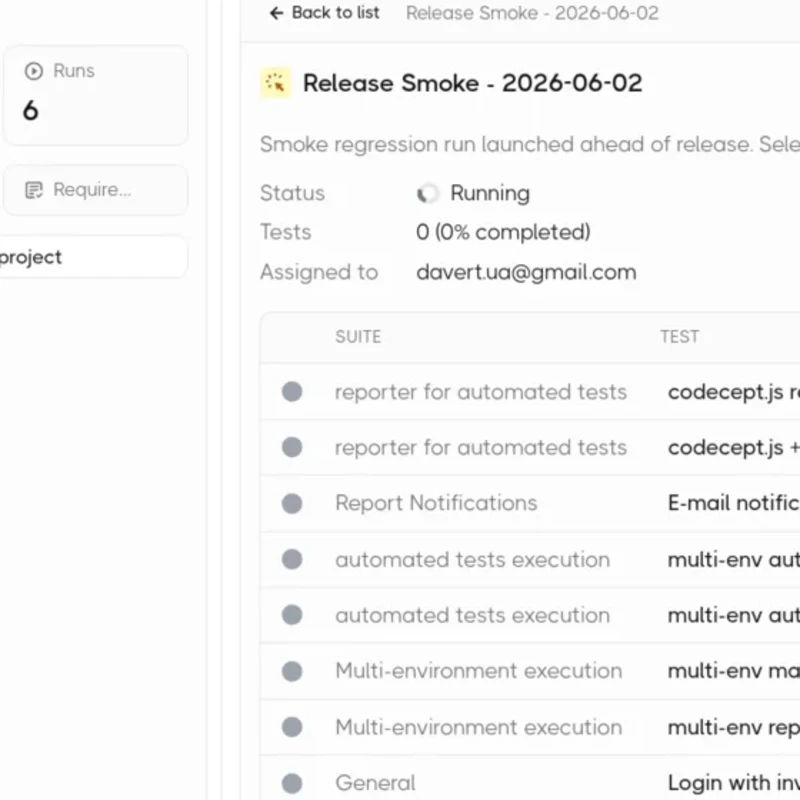
A QA agent that moves manual testers to QA AI Engineers. Testing skills, workflows and automations are built in, connected to your Testomat.io project, on your desktop and in CI.
An autonomous agent that tests what no one wrote a case for. It clicks through real flows, finds edge cases and reports what manual testers miss.
Anyone can spin up an agent and say they tested it. But where is the proof? A strategy needs one control room the whole team can watch: what passed, what failed, what is still untested. Without one place everyone trusts, testing is just noise. That is why we built Testomat.io, and why it matters more in the AI era, not less.
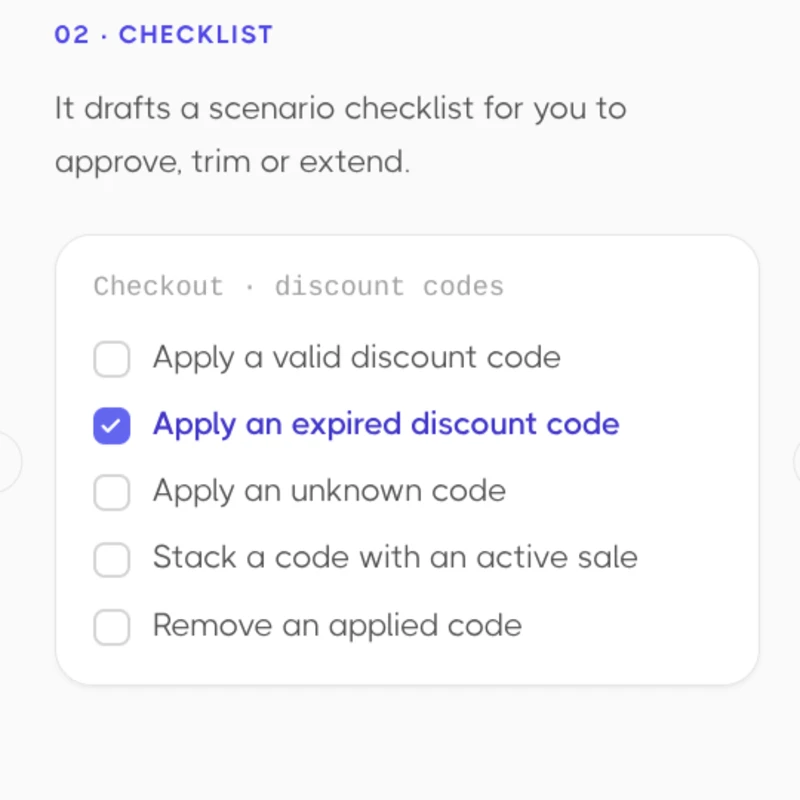
AI reads the requirement behind a feature, pulled from Jira, Linear, Confluence, Figma or Miro over MCP, and drafts a checklist of cases for you to approve. Nothing slips between the ticket and the tests.
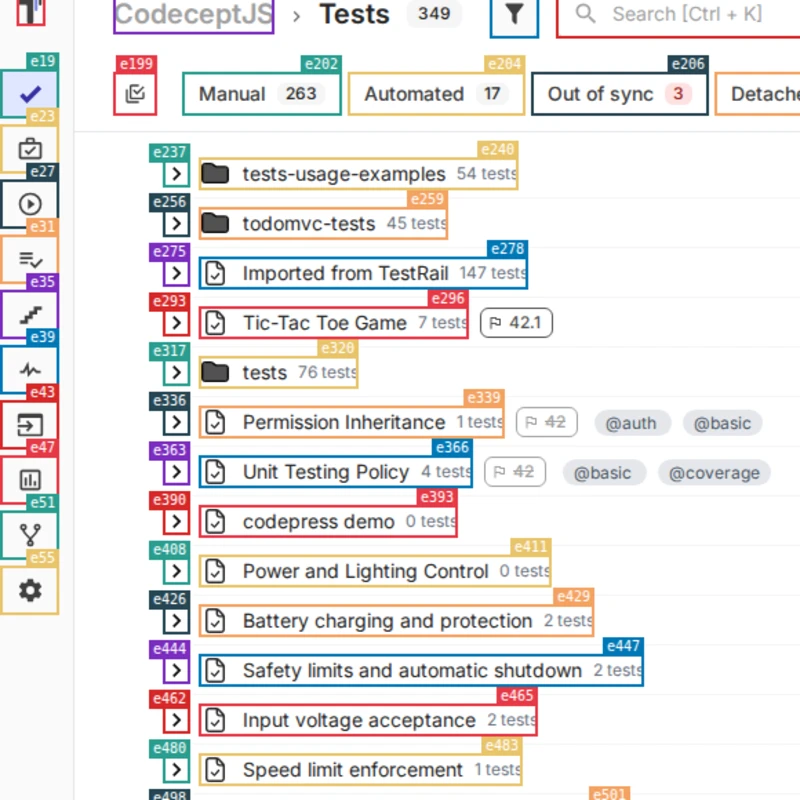
Testomat.io is your test management system. Cases live as Markdown in the repo, so agents and people edit them the same way. They sync to Testomat.io on a schedule, so the whole team works from the same cases.
AI writes cases faster than anyone can read them, and pushing them straight to main turns your docs into a mess. Branches hold new cases for review, so only approved ones reach the main project.
Manual and automated tests sit in one project, so you always know what code covers and what it does not. The reporter plugs into any framework and sends results back with screenshots, video and steps as evidence.
Every PR brings unit tests, but who runs regression for each change? Coverage mapping picks the affected cases and builds a small run from just those. The agent drafts cases for the new behavior and sends them to a branch for review. Explorbot explores the feature first, before manual QA steps in.
Once the process runs, results flow in across every area. Your job is to watch the stream and dig in when it counts. You cannot read every report, so AI summarizes them and flags only the points that need attention.
Each release feeds the next. Coverage grows while your team focuses on the hard problems.
AI turns each change into test cases, stored as markdown in your repo.
New cases wait on a branch for review before they reach the main project.
Manual cases become real tests that report back to your TMS.
Coverage mapping runs just the cases a change can break.
Results stream into one dashboard, and AI flags what needs you.
Watch the swarm work in real time and walk into release meetings with the full picture.
1 blocker · 1 flaky test to review
412
passed
6
flaky
1
failed
faster test creation
from intent to passing test
less regression effort
maintained by agents, not people
autonomous exploration
Explorbot never sleeps
agents in a swarm
running fully in parallel
Connect your repo and let Testomat.ai plan, automate and explore your way to a calmer release.